A Latter-day Bluestocking

For the love of reading

In Which Henry David Thoreau confirms a place-name

There is a wonderful place in Maine where the loons call and the water laps against the shore, and the smell of earth, pine and cedar permeate the air.  It is a place absent of electricity and plumbing and it is, to me, the best place on earth.  It is the absolute best place to read; whether indoors sitting in front of the large fireplace with the wood crackling, sending up sparks or outside on the back porch with Borestone solemnly rising in the distance, a gentle breeze rippling across the lake, and the promise of a breathtaking sunset.

It is here a few summers ago I decided to undertake the reading of Henry David Thoreau’s The Maine Woods, an interesting read if at times a difficult one.  It is a slow-moving book and took me a good deal of time to complete.  Thoreau’s writing is devoid of poetry and is very matter-of-fact and dry.  Despite this, his descriptions left an indelible hold on me and like those places he describes the book forces one to slow down, to stop and smell the flowers.

One of the things I liked most was Thoreau’s care and attention to detail, painstakingly describing the places, documenting the flora and fauna, and the Native American words for things.  I was delighted to find one of these terms, pokelogan.  There is a spot here that the family have always called pokelogan, a marshy, damp spot awash in lily pads, and occasionally covered in coarse grass where moose have been occasionally spotted.  The origins of the name were sufficiently lost in recent memory (at least to me); that’s what the place was called and I never thought to question why.  As a kid, trying to get the canoe around “Poky Logan”, when the water was low, was near impossible and the word “poky” apt because of the sluggish struggle to paddle through.  I always assumed this was the origin of the name and never wondered who or what “Logan” was.

The words of Thoreau  brought enlightenment, given the following passage:

“They [the moose] were particularly numerous where there was a small bay, or pokelogan, as it is called, bordered by a strip of meadow, or separated by from the river by a low peninsula covered with coarse grass, wool-grass, etc., wherein they had waded back and forth and eaten the pads.”

Of course, I probably could have asked the older generation of aunts and uncles and cousins to find the origin of the place-name but that would not have given me the pleasure of discovering it for myself.  The realization that my great-great-grandfather most likely read the posthumously published (1864) Thoreau tome, and may have chosen to use the native term to describe our “pokelogan” is a powerful one and doubly so because “my discovery” resulted in  feelings of closeness to him despite the span of generations.

The Curious Case of Artemus Ward

Artemus Ward, from book Wit and Humor of the A...

Image via Wikipedia

“The village from which I write to you is small.  It does not contain over forty houses, all told; but they are milk-white, with the greenest of blinds, and for the most part are shaded with beautiful elms and willows.  To the right of us is a mountain to the left a lake.  The village nestles between.  Of course it does, I never read a novel in my life in which the villages didn’t nestle.  Villages invariably nestle.  It is a kind of way they have.”  (Affairs Around the Village Green)

Waterford, Maine

I have returned to the village, Waterford, Maine, in which my grandmother was born and where I lived when I was born.  Albeit, the elms are now gone, a victim of Dutch Elm Disease, but it is still a “small and nestling” place.  I climb the mountain and swim in the lake.  It is a village my family have returned to practically every summer.  My grandmother lived there year-round as does my sister now.  I am drawn to it as a migratory bird is drawn back to its nesting grounds.  It is a place that renews my soul and the one place I truly feel is home.

Birthplace of Artemus Ward (Charles Farrar Browne)

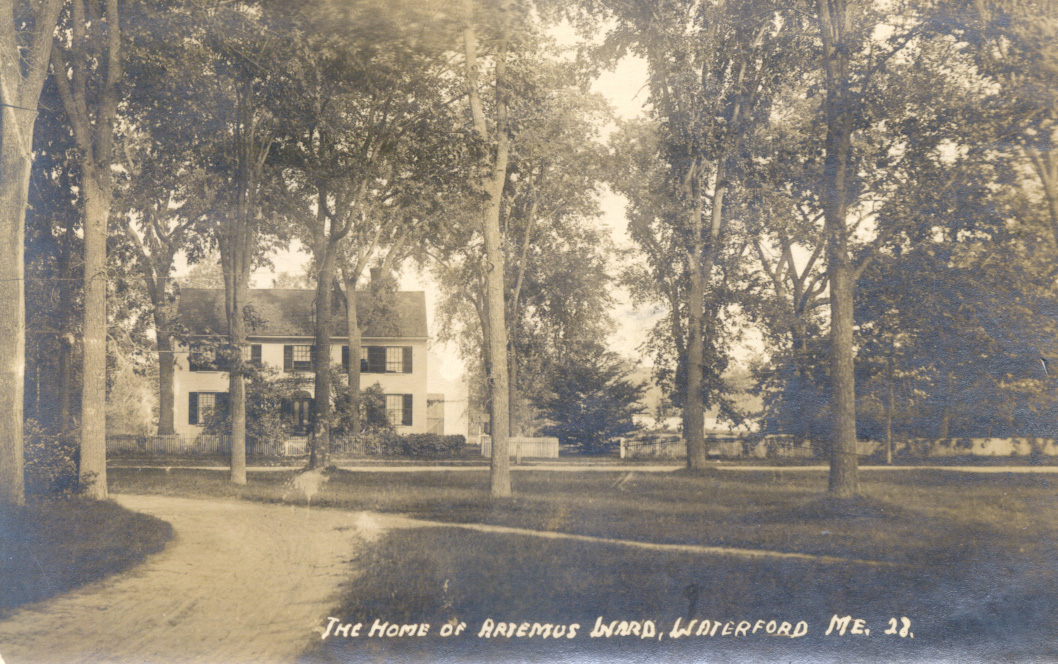
Ever since I could remember, there has been a sign on the common which mentions the founding of the village, when it was incorporated, and the fact that it was the birthplace of Artemus Ward (April 26, 1834–March 6, 1867).  As a snot-nosed kid, this fact did not mean much to me but one day I discovered a book, Works by Charles Farrar Brown, amongst the shelves at my grandparents’ home.  As I was flipping through it I found that the author of the stories wrote under the pen-name of Artemus Ward.  That large house across the common was where this once anonymous person was born.  Funny, who knew?  I hadn’t.

Charles Farrar Browne or Artemus Ward was a humor writer and a very popular one, apparently.  He was widely read in the United States as well as Great Britain and was in England, on a reading tour, when he became very ill and died at the age of 32.  He was one of Abraham Lincoln’s favorite writers and it is alleged that he read to his cabinet one of Ward’s articles before getting down to the business of presenting his Emancipation Proclamation.  Artemus Ward was also said to have inspired his contemporary, Samuel Clemens, better known as Mark Twain.

One of the stories in that book I stumbled upon, “Affairs Around the Village Green”, was particularly interesting because Artemus Ward perfectly describes the place that has meant so much to me.  That the little hamlet of Waterford had changed so little since his time, my grandmother’s time, and my father’s time gave me a sense of continuity and connection, one I could never have in New York.  And one day I will return there for good…it is a wonderful thing!

“Why stay in New York when I had a village green?  I gave it up, the same as I would an intricate conundrum and, in short, I am here.”

Quote of the Day: Artemus Ward

Artemus Ward, from book Wit and Humor of the A...

Image via Wikipedia

“Do I miss the glare and crash of the imperial thoroughfare?  The milkman, the fiery, untamed omnibus horses, the soda fountains, Central Park, and those things?  Yes I do; and I can go on missing ’em for quite a spell, and enjoy it.”  (Artemus Ward, 1834–1867)

In recognition of the fact that I am going on holiday to relax, enjoy family and to READ!

Daily Quote: A poem by Arnold Lobel

frog and toad

Image by justaghost via Flickr

Books to the ceiling

Books to the sky,

My pile of books is a mile high.

How I love them!  How I need them!

I’ll have a long beard by the time I read them.

Arnold Lobel, 1933–1987

Quote of the Day: Walt Whitman

Photo of American poet Walt Whitman. Caption r...

Image via Wikipedia

“The dirtiest book of all is the expurgated book.” Walt Whitman, 1819–1892

Why I gave up on ""Fear and Loathing in Las Vegas" by Hunter S. Thompson"

Cover of "Fear and Loathing in Las Vegas:...

Cover via Amazon

I didn’t so much as give up on Fear and Loathing in Las Vegas as I couldn’t get started!  I am not sure why exactly except the mood I was in couldn’t take the characters and their perpetual state of impairment.  I had no patience for it; perhaps I’ll pick it up again when I am in a better mood.

Quote of the Day: Ernest Hemingway

Hemingway posing for a dust jacket photo by Ll...

Image via Wikipedia

“There is no friend as loyal as a book”  Ernest Hemingway, 1899–1961

Quote of the Day: Henry Ward Beecher

Henry Ward Beecher. Library of Congress descri...

Image via Wikipedia

“Books are not made for furniture, but there is nothing else that so beautifully furnishes a house.”  Henry Ward Beecher, 1813–1887

Books to read again, again, and again, ad infinitum.

Rainy Day in Brooklyn

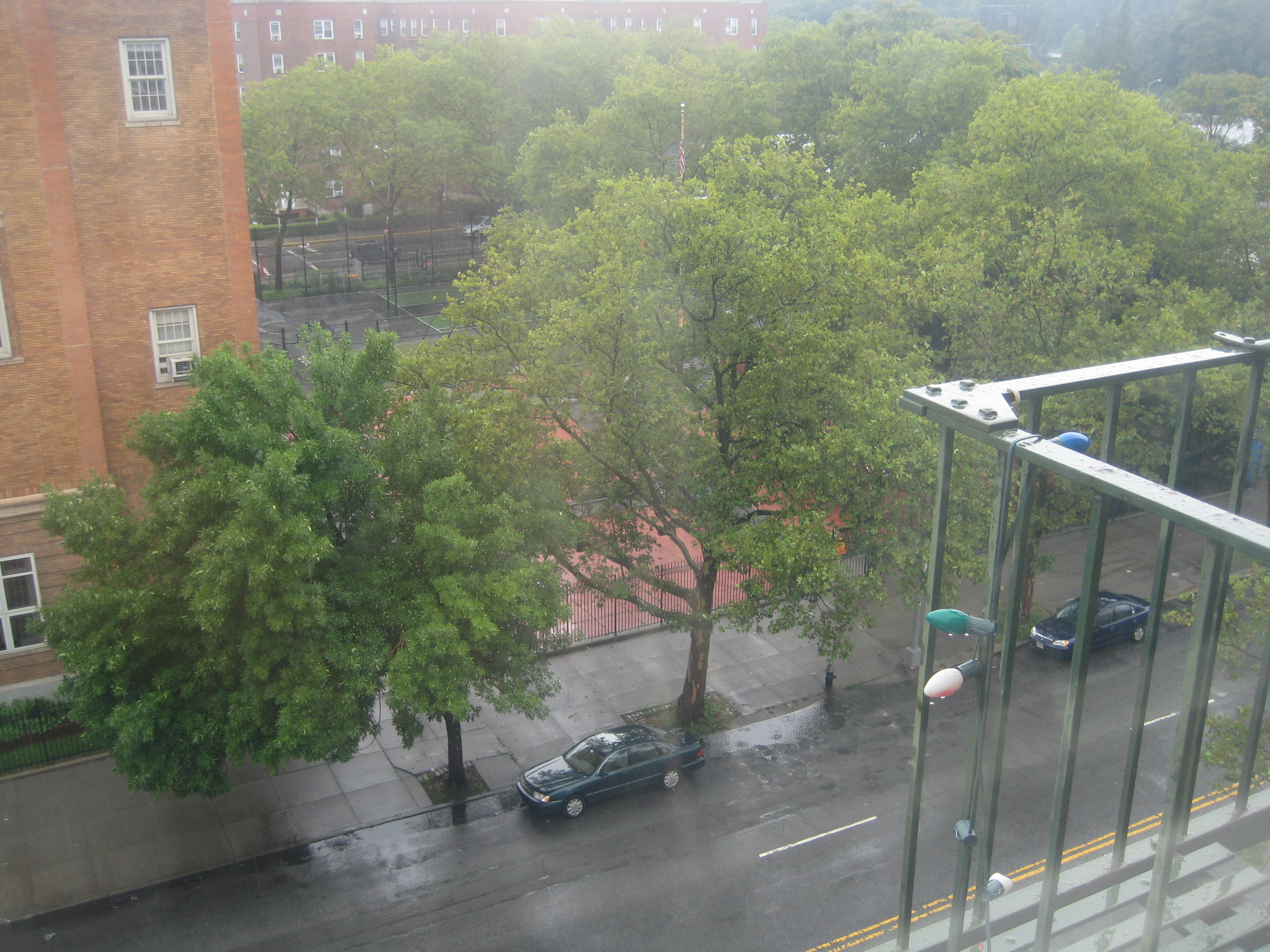
It is raining, and not just raining but pouring!  Bucket after bucket of water pouring off the rooftops so loudly it sounds like a gentle roar on my apartment’s ceiling.  The spray as cars drive by, the individual drops off my fire escape sounds like a shower left to run.  Most people see a day like today as dreary and depressing, there are times when I do too, but on a lazy Sunday I am looking forward to reading.  I will roam from bedroom to living room and curl up on the bed or sofa and indulge myself in a good book.

Cover of "The Wind's Twelve Quarters: Stories"

Today I happen to be reading Ursula K. Le Guin’s The Wind’s Twelve Quartersa book of 17 short stories each introduced by the author.  It is a great read for a day such as today because an intense commitment is not necessary as with a novel.  A story can be finished, the book put down (albeit temporarily) after all one does have to eat.  And for some reason, rainy days have always been good days to read stories of fantasy, magic, and science fiction.  I don’t know exactly why that is but I like to imagine that as the rain cleanses the earth, stories that have a magical element cleanse the mind and open it up to possibilities beyond the mundane.  Too romantic, I know.

It is days such as this when I reflect on all the books too good to just molder on shelves, or in my case piled on floors in front of over-filled bookshelves, books that should be read again and again.  A few favorites come to mind, Jane Austen for example.  All her books (Juvenilia and letters) can be read over and over and never become stale.  There is not a year that passes that I do not reread one of her books (or more); one year focusing on plot, another on character, and yet another on the period in which the stories take place (things that Austen would have taken for granted that her reader’s would know).  Others include, Tolkien, Bronte, Doyle, Hardy, Shelley, and Lewis.  A rereading of To Kill a Mockingbird by Harper Lee is essential if only for its lessons on the wrongs of racial inequality and the integrity of its hero, Atticus Finch.  This is a book on how we should behave but seldom do.

My list has changed over the years, evolved.  When I was 16 I reread A Room with a View so many times that the cover is in tatters and now I barely give it a second glance; not because it isn’t a wonderful book, it is, but now with more decades under my belt than I care to admit it doesn’t speak to me in the same way as A Tree Grows in Brooklyn does.  That is the beauty of books, they evolve with the reader.  For example, D.H. Lawrence’s Lady Chatterley’s Lover.  First read when I was 12 or 13 1) because it was on a banned book list and 2) I was curious about sex.  When I first read it I was titillated by the frank descriptions of copulation and didn’t remember much beyond that.  I reread it again in my early 20s, now living with a boyfriend, and found myself bored by the book, my lack of innocence relegating the book to a place of stuffy indifference.  I recently reread it yet again, a middle-aged woman separated from her husband in the midst of divorce, and finally “got it”; understood what Lawrence was trying to convey in this story:  a wholeness of life is necessary in the pursuit of happiness.  Well, at least, that’s what I “got” from it.

Here are ten books that I believe should be read again, again, and again, ad infinitum.

  1. J.R.R. Tolkien, The Hobbit and The Lord of the Rings trilogy.  (because they are great stories)
  2. Jane Austen, Pride and Prejudice.  (probably one of the most perfect books in the English language)
  3. Charlotte Bronte, Jane Eyre.  (its themes of atonement and forgiveness)
  4. Sir Arthur Conan Doyle, Sherlock Holmes stories and The White Company (great story-telling)
  5. Isak Dinesen, Out of Africa and Shadows on the Grass (brilliant memoirs)
  6. Roald Dahl, Charlie and the Chocolate Factory  and The Witches (because they are so fun to read aloud and make your kid laugh, especially when done with voices)
  7. Virginia Woolf, Mrs Dalloway (for its themes of feminism, mental illness, and existentialism)
  8. Ursula K. Le Guin, The Earthsea Cycle (because they are so wonderfully written and have a lot of themes to explore)
  9. Mary Shelley, Frankenstein (a moralistic story about the over-fulfillment of modern man: a good narrative and appropriate for our time)
  10. F. Scott Fitzgerald, The Great Gatsby (a vivid and unromantic view of the fragmentation of the American Dream)

Wow!  That was harder than I thought it was going to be.  I am happy to say that my list has 6 women authors; is somewhat well-rounded, consisting of classics, fantasy, and science-fiction (Frankenstein); and has American and English (and one Danish) authors.  These are books I consider worth rereading and probably says more about me personally at this particular moment in time than anything else.  Your list may be different.  Reader, I would love to hear about the books you think are worth rereading and why.  Leave a comment, I would really like to know.

Okay, now I have to get back to reading!

Quote of the Day: Erasmus

Portrait of Erasmus of Rotterdam, 1523. Oil an...

Image via Wikipedia

“When I get a little money I buy books; and if any is left I buy food and clothes.”  Desiderius Erasmus, 1466–1536