A Latter-day Bluestocking

For the love of reading

Category: Jane Austen

Lost in Austen

I have recently picked up a book that I can’t seem to embrace.  Not because of the subject matter, March, an historical fiction by Geraldine Brooks, would normally be something I would be all over.  It is the story of the absent father, Mr. March, of Louisa May Alcott’s Little Women and documents his experiences during the Civil War while his “little women” tend to the home fires.  I will go back to it certainly but right now I have many on-going  literary projects focusing on Jane Austen and I find myself preoccupied by her and repeatedly drawn into her world.

This month my book club, The Petty Rebuttals, are reading Pride and Prejudice.  It is my turn in the line-up, and since we collectively decided to read classics this cycle, I chose to introduce the group to Jane Austen.  We are a mixed bag,  evenly divided of those who have read P&P and those who have never had the pleasure.  I am excited to give my insight to the group and share my love and enthusiasm for this novel (and of Jane) and only hope that I don’t overwhelm the group with my zeal.  P&P is universally acknowledged (yes, that was intended) to be one of Austen’s best novels and I am currently trying to decide what of the novel I want to focus upon.   Do I focus on character, storyline, class?  My latest re-reading I specifically examined the characters of Elizabeth and Darcy, their imperfections and their strengths.  I am intrigued how they evolve through the story and am struck by their capacity for self-awareness.  Both come to terms with their pride and prejudice and become mindful of helping one another to overcome their shortcomings and give prominence to their assets.  In other words, form a true partnership of  like mind and heart.  I think I will allow the group to take initiative though, regardless of where the discussion leads it, no doubt, will be stimulating.

I am also preparing to lead a discussion next month for the Jane Austen Reading Society.  I am thrilled to be presenting Catharine, or the Bower.  A work of Jane Austen’s Volume, The Third of her Juvenilia.  A charming piece, written in 1792 when she was only 16 years old.  It is an unfinished story,  predominately for the gratification of her family but has enticing elements present in her more mature works.  The diversity in characterization and domestic realism is already evident in this short piece; it exhibits her wit and seemingly light and playful prose but also emerging is her perceptive understanding of class, gender, social decorum, and wealth.  It is an important piece still raw in its youthful vivacity but intimates a more developed novelistic approach as she attempts to move away from her earlier mocking works.  Catharine highlights the potential of the young Jane Austen’s scrutinizing eye and sardonic humor that fans know and love and appreciate.
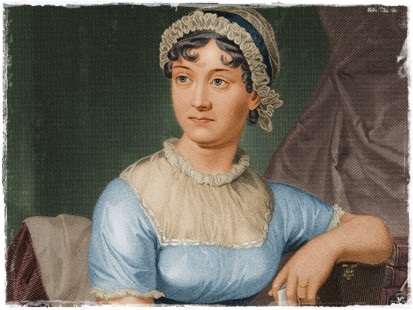
A lamentable picture of an insipid Victorian-friendly Jane Austen. She's wearing a wedding band for crying out loud!!!!

In anticipation of all of this, or perhaps in consequence of, I have undertaken a biography I have not read before.  My favorite has always been that by Claire Tomalin but I decided to give David Nokes’s biography, Jane Austen:  A Life, a go.  Both biographers diverge from the generally accepted portrayal of Jane Austen as the staid and dour spinster, happy and accepting in her quiet life of little event.  This myth of Jane Austen was perpetuated by her family soon after her death, in fact, her tombstone at Winchester Cathedral doesn’t even mention that she was an author and became more pronounced as Georgian England became Victorian England.  In the Victorian era, a woman’s place was the domestic sphere; home life and motherhood were considered all that was necessary for a woman’s emotional fulfillment.  Reading the little that is left of Jane Austen’s letters, her Juvenilia, and her novels it is clear that Austen was not willing to place her well-being in a virtuous ideal of femininity.  She was feisty, opinionated, mirthful, and cutting.  She wasn’t one to not cut to the chase and often described things the way they were, albeit with a derisive wit.  Comments to her sister in letters emphasize her dry humor: 

 “I give you joy of our new nephew, and hope if he ever comes to be hanged it will not be till we are too old to care about it.” [upon the birth of a nephew]

“Here I am once more in this scene of dissipation and vice, and I begin already to find my morals corrupted.”  [upon arrival in London]

“How horrible it is to have so many people killed! And what a blessing that one cares for none of them!”  [commenting on the Peninsular War]

“You express so little anxiety about my being murdered under Ash Park Copse by Mrs. Hulbert’s servant, that I have a great mind not to tell you whether I was or not.”

I love the “rebellious, satirical, and wild” Austen!  This Jane and I could be great friends unlike the virtuous, devoted, and retiring maiden Aunt popularly portrayed for nearly 200 years.

Quote of the Day: Jane Austen

Back View of Jane Austen, Watercolor

Image via Wikipedia

“I declare after all there is no enjoyment like reading! How much sooner one tires of any thing than of a book! — When I have a house of my own, I shall be miserable if I have not an excellent library.”  Jane Austen, Pride and Prejudice


Out and About with Jane and the Sordid in 7 hours

A corned beef sandwich from Katz's Delicatesse...

Image via Wikipedia

This weekend is again shaping up to be perfectly literary.  Today I meet with my book club, The Petty Rebuttals where we will be discussing Room by Emma Donoghue and tomorrow is the Brooklyn Book Festival where I will be manning the Jane Austen Society of North America’s table for an hour in full Regency dress!!  But more about that later because I want to tell you about last weekend that proved to be very literary as well.

Saturday began quite bookish.  Its scope spanned the centuries beginning with Jane Austen and ending with what was promised to be a sordid foray into international erotic writing.

My day began with the New York Regional meeting of the Jane Austen Society of North America (JASNA).  A group of like-minded admirers of the works of Jane Austen who come together at regional meetings throughout the year, an annual national general meeting, and at splinter group meetings such as a monthly discussion group, book reading groups and the Juvenilia (a group for the young and the young at heart).  This meeting was especially enticing for me as it would be a lecture on fashion of the Regency era and how best to outfit yourself at any budget entitled, Dressing the Miss Bennets.  The speaker was Lisa Brown who led the informative lecture with modeling (which I happily participated in).

I had such a wonderful time, catching up with friends, volunteering, and talking about an upcoming general meeting which our chapter is hosting in Brooklyn next autumn.  It was exciting to discuss Jane Austen with other enthusiastic readers.  It is a wonderful place to socialize with the scholarly as well as those who have newly discovered our favorite author.  I was able to discuss with fellow members of the Juvenilia the possibility of a lending library amongst our members of our personal Jane material and the possibility of leading a group discussion in November of Catherine, or the Bower an unfinished fragment written in August 1792.  This is an important fragment as it is believed to be a segue between Austen’s youthful juvenilia to her mature published works.

After tea and cucumber sandwiches with the group-at-large, myself and members of the Juvenilia group headed to Manhattan’s lower east side to participate in the 4th Annual Lit Crawl NYC.  This event is sponsored by the Litquake Foundation, founded in San Francisco, to give readers more against the back-drop of technology by promoting readings, classroom visits, youth projects all “to foster interest in literature for people of all ages and perpetuate a sense of literary community.”  The Crawl was broken up into three 45 minute phases in which you chose from several topics and venues (coffeehouses, bars and lounges).  The first venue we decided to attend was sponsored by The Center for Fiction in which authors came up with he first line of books based only on the title and a blurb.  Audience participation involved trying to guess what the correct first line was.  It was very fun and sometimes raucously hilarious!!  The second venue we chose was Nerd Jeopardy presented by publishers Farrar, Straus, Giroux.  This one is pretty self-explanatory and one would be led to believe a fun choice but because of the lack of organization and slim audience participation it proved a bit boring and pretentious.  The best part of this venue was the Heineken Dark Lager.

Next venue, in the hopes of more than just intellectual stimulation we chose to attend Down and Dirty Round the World the blurb read as follows:

“…an evening of hardboiled, pulpy, and erotic international literature read by some of our favorite authors and translators…”

It proved less than exciting.  None of the selections even came close to being pulpy or erotic.  Halfway into the first reading my friends and I were wondering if we should just bail.  One author/translator read so poorly that if she were to read hard-core porn her monotone voice would fail to titillate.  At last it was over!  It had one thing going for it, it gave us something to talk about.  The only thing about that evening to arouse my desire was the to-die-for pastrami Reuben at Katz’s Deli!  That succulent pastrami, its juicy goodness tantalizing my tongue, the tender flesh melting in my mouth… See what I mean?

Jane Austen and Firefly. Wait!!…What??

Title page from the first edition of the first...

Image via Wikipedia

Folks who know me are aware that besides being a literature reading junkie I am also a sci-fi fanatic.  My reading in the genre has been meager and I am remedying that.  I have read and loved Starship Troopers, Fahrenheit 451, and The Left Hand of Darkness.  I have to admit that the majority of my fondness for science fiction has come from the medium of television and film:  Star Trek, Star Wars, Space 1999, Battlestar Galactica, and Buck Rogers.  Yes, I’ve dressed Trek (Original Series only, thank you) and Star Wars (Princess Leia, slave Leia if you’re lucky) but don’t hold that against me.

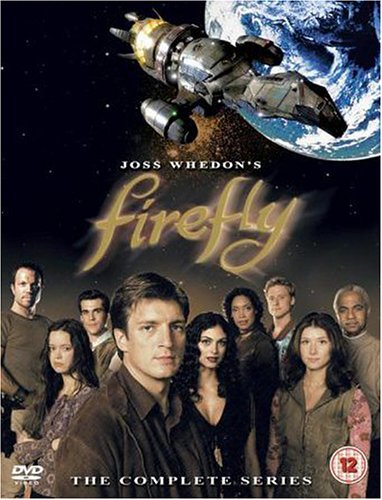
The one sci-fi preoccupation I love the most and simply cannot live without is Firefly.  Yep, the defunct, didn’t make it a season, space-cowboy, all chock-full of goodness television show.  Love it, love it, love it!  That’s right if I were stranded on a desert island that just happened to have a DVD player and a television and presumably electricity there are two things I must have so I don’t go all-Lord of the Flies:  the book, Pride and Prejudice and the DVD boxed set of Firefly.  I know what you are thinking:  “Wow, that woman is totally out of her mind!!”  But before you run with that allow me to explain why I feel these two very different genres may not be as incompatible as one would presume.  And, no, it’s not because of Mr. Darcy and Capt. Reynolds.

Characterization!  Jane Austen is a genius when it comes to her characters.  Despite the fact that her stories are confined to a limited society she spans the width and breadth of human mettle as well as foible.  Who hasn’t chanced upon someone as arrogant and pedantic as Lady Catherine de Bourgh or an insipid flatterer as Mr. Collins.  It has been written in a contemporary criticism that Jane Austen handled character with a masterly “perception of its more delicate shades.”  In other words, the men and women Jane Austen describes are true representations and not caricature, not two-dimensional and her characters do not lack fault but are nonetheless charming.  G.H. Lewes wrote of her writing in 1847:

“What we most heartily enjoy and applaud, is truth in the delineation of life and character:  incidents however wonderful, adventures however perilous, are almost as naught when compared with the deep and lasting interest excited by any thing like a correct representation of life.”

And characterization is what is most appealing about Firefly.  The creator, Joss Whedon, has created dramatis personae who are engaging and interesting; every role has depth and more to it than meets the eye, again no two-dimensional characters here.  The nine people on board Serenity are not perfect (except Kaylee, “I don’t believe there’s a power in the ‘verse that can stop Kaylee from being cheerful.”) and yet they have a dynamic that is genuine, they too struggle with self-reproach, doubt, and questions of right and wrong.  These characters exhibit the same shortcomings that we can relate to and because of this, the canceled show which only consisted of 14 episodes (only 11 were actually aired) has taken on a life after death existence amongst devotees (called “Browncoats”).

So as you can see, Jane Austen’s Pride and Prejudice and Joss Whedon’s Firefly although very different are not very dissimilar when it comes to characterization and each’s ability to transcend the story and make each character a genuine entity.  I think this is why they appeal to me, the inhabitants of each genre speak to me and I can see myself in them.  But it doesn’t hurt that they have:

Him

and Him

Jane Austen’s Fight Club

I want to share this link because I am on a serious Jane Austen bender at the moment (when am I not?) and I think this is an amusing and raucous mashup.  I’ve seen it so many times and yet I am still laughing.  Enjoy.

“I dearly love a laugh… I hope I never ridicule what is wise or good. Follies and nonsense, whims and inconsistencies do divert me, I own, and I laugh at them whenever I can.” (Pride and Prejudice)

Jane Austen’s Fight Club on Vimeo

Why Jane Austen? Why, indeed!

I have just finished Why Jane Austen? by Rachel M. Brownstein.  It is a scholarly book, a serious discourse that attempts to interpret why Jane Austen is considered such a great writer and why she has become such a phenomenon in this day and age.  The author strives to explain and understand from many viewpoints: Jane Austen’s contemporaries, her family, the young girls who are looking for a simple courtship story, women who see early feminist messages á la Mary Wollstonecraft, white-haired ladies who ooh and aah at the neat writing of her manuscripts and letters, and the zealots who would defend, to the death, her genius.  It is a well-written book; the author, a professor at Brooklyn College and the CUNY Graduate Center and who has lectured at meetings of the Jane Austen Society of North America (JASNA), knows her stuff.  I enjoyed reading it but found parts of the book dry and, at times, confusing.  I am wondering if my dense reading of this book is because it wasn’t what I expected.  The well-known axiom, “don’t judge a book by its cover” is appropriate here as the cover picturing a Jane Austen “action figure” atop a stack of books belies its content.  I thought it would be a “light, bright and sparkling” book appropriate for summer holiday reading.  Beach reading it was not.

No sooner had I read the last page I began to question why I love Jane Austen so much.  Oddly enough, it is a tough question to answer, most likely because my outlook towards her has changed over the years.  I must admit I came to her quite late.  I never read Pride and Prejudice as a giddy schoolgirl; I discovered her in college.  I am embarrassed to say that my introduction to Jane Austen was through the BBC production of Pride and Prejudice starring Jennifer Ehle and Colin Firth as Elizabeth and Darcy.  I remember loving it as I tried to watch while being teased by a neanderthal who felt that the highly mannered society, the clothes and stately settings, and period language were pretentious.  I read the book and soon after the other five novels.  I fell in love.

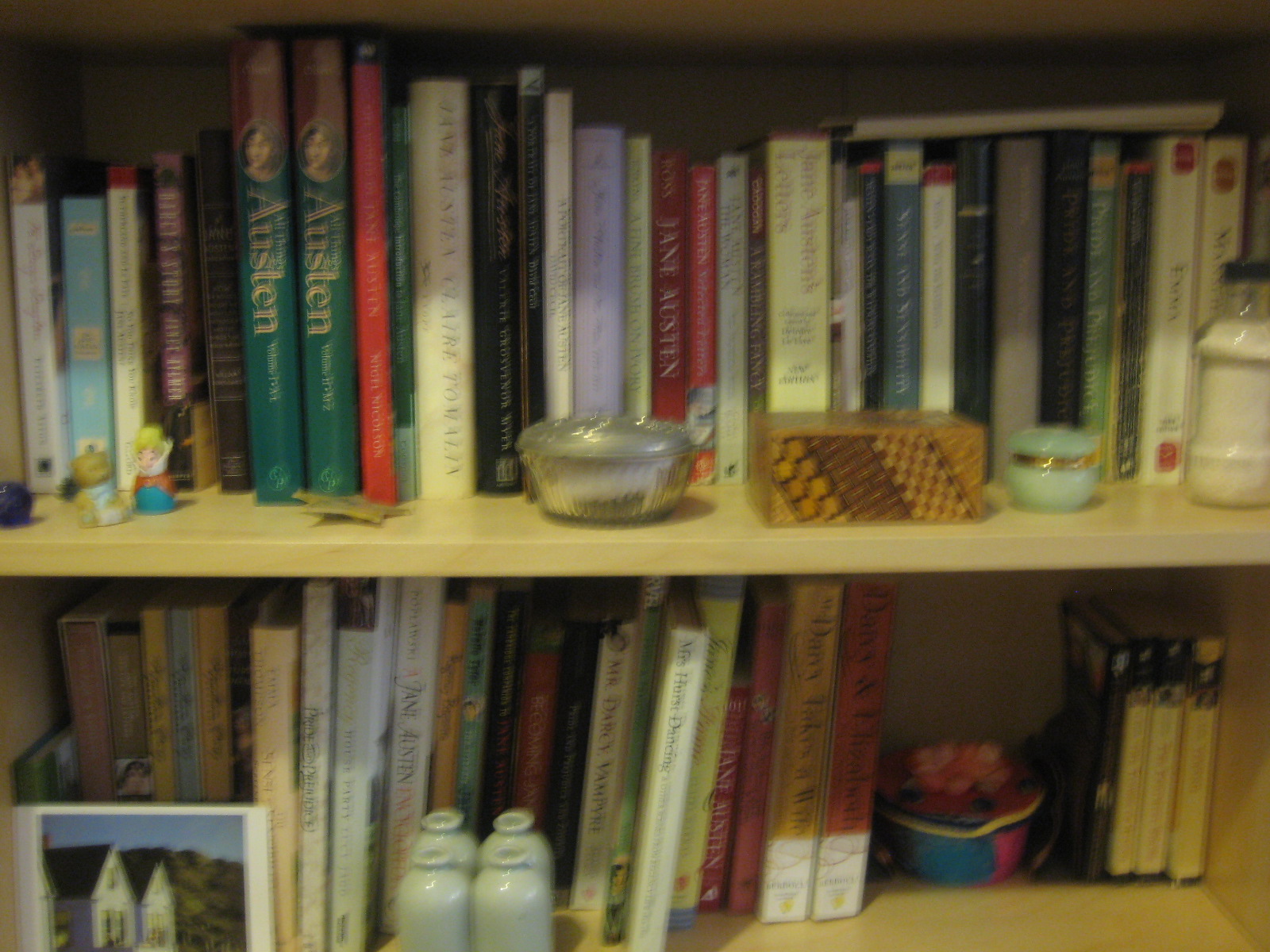
A small part of my Jane Austen collection

Since then, I have read the biographies, the Juvenilia, the letters, magazines, articles, on-line blogs, and have re-read the books countless times.  I would rather go hungry than not purchase the newest edition of any of the novels, biography, or critical essays.  I even watch and enjoy the cinematic versions of the books and Jane Austen’s life.  My favorite P&P is no longer the Firth one; he being much too Byronic for my tastes and not the Darcy of the novel.  I have read each book in different ways, sometimes I focus on character, sometimes it’s the language, I like to focus on reading between the lines to gently uncover Jane Austen’s witty and humorous and very accurate assessments of the people we still come into contact today.  She was a master of language; her writing so exquisite and at the same time so humble.  Unless you are looking for it this can be easy to miss.   Virginia Woolf summed it up best in A Room of One’s Own,

“Anyone who has the temerity to write about Jane Austen is aware…that of all great writers she is the most difficult to catch in the act of greatness.”

So why Jane Austen?  Because I am the giddy girl seeking romance, the intellectual woman looking for discourse on the perfect novel, the feminist fighting for female independence and a break from the accepted docile rendering of womanhood, the gray-haired lady who values penmanship, civility, and manners.  Jane Austen answers to all of these various parts of my personality and so much more.  I’ve never been let down by her and have always been able to find a kernel of wisdom, laughter, and joy no matter my mood.  Her words have uplifted my spirits, answered difficult questions, and given me an understanding of people through the behavior of her characters.  She is great.  It is as simple as that.

Quote of the Day: Jane Austen

Title page from the first edition of the first...

Image via Wikipedia

“All this she must possess,” added Darcy, “and to all this she must yet add something more substantial, in the improvement of her mind by extensive reading.”  (Pride and Prejudice, Vol I., Ch. VIII)

Books to read again, again, and again, ad infinitum.

Rainy Day in Brooklyn

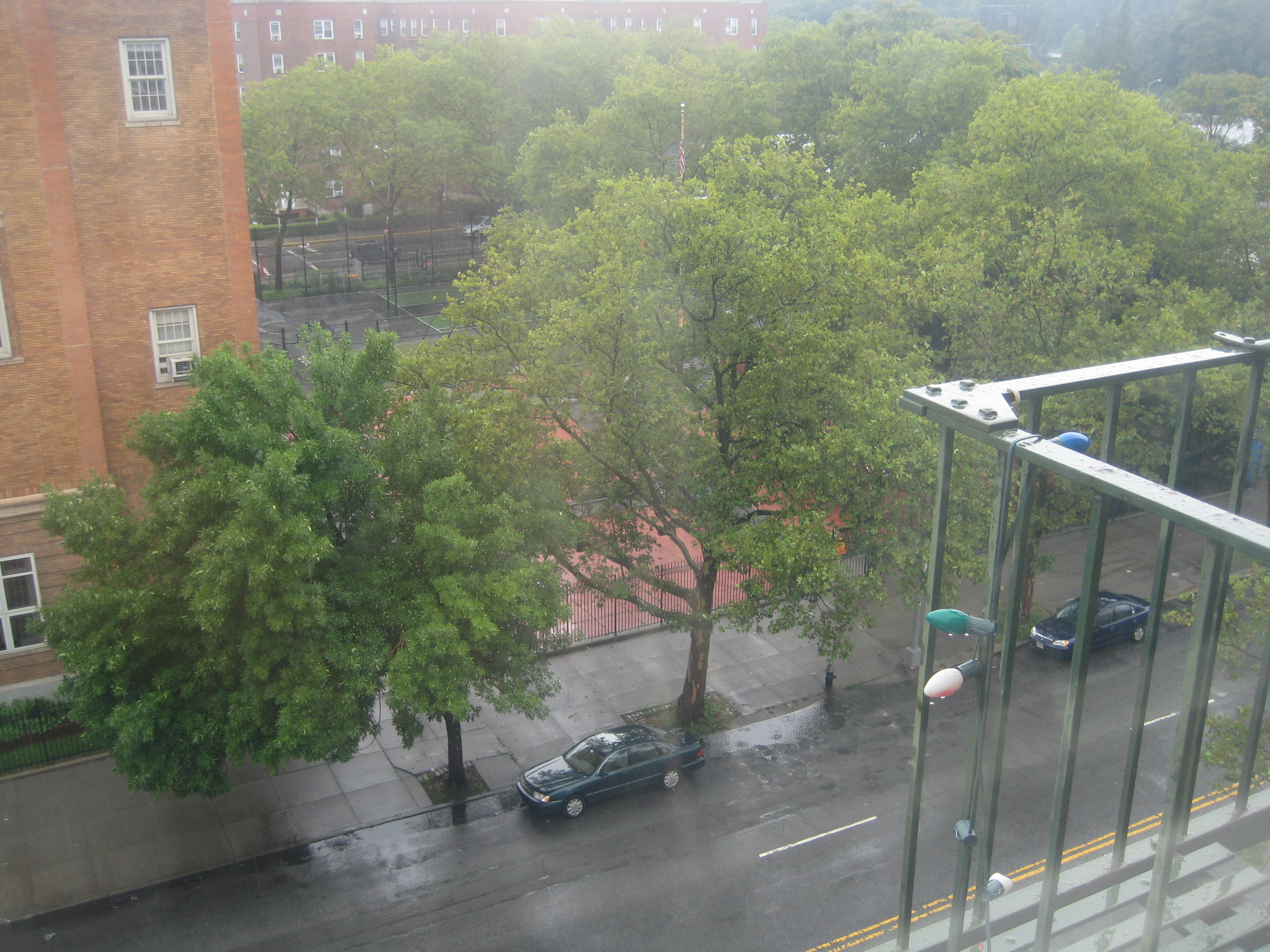
It is raining, and not just raining but pouring!  Bucket after bucket of water pouring off the rooftops so loudly it sounds like a gentle roar on my apartment’s ceiling.  The spray as cars drive by, the individual drops off my fire escape sounds like a shower left to run.  Most people see a day like today as dreary and depressing, there are times when I do too, but on a lazy Sunday I am looking forward to reading.  I will roam from bedroom to living room and curl up on the bed or sofa and indulge myself in a good book.

Cover of "The Wind's Twelve Quarters: Stories"

Today I happen to be reading Ursula K. Le Guin’s The Wind’s Twelve Quartersa book of 17 short stories each introduced by the author.  It is a great read for a day such as today because an intense commitment is not necessary as with a novel.  A story can be finished, the book put down (albeit temporarily) after all one does have to eat.  And for some reason, rainy days have always been good days to read stories of fantasy, magic, and science fiction.  I don’t know exactly why that is but I like to imagine that as the rain cleanses the earth, stories that have a magical element cleanse the mind and open it up to possibilities beyond the mundane.  Too romantic, I know.

It is days such as this when I reflect on all the books too good to just molder on shelves, or in my case piled on floors in front of over-filled bookshelves, books that should be read again and again.  A few favorites come to mind, Jane Austen for example.  All her books (Juvenilia and letters) can be read over and over and never become stale.  There is not a year that passes that I do not reread one of her books (or more); one year focusing on plot, another on character, and yet another on the period in which the stories take place (things that Austen would have taken for granted that her reader’s would know).  Others include, Tolkien, Bronte, Doyle, Hardy, Shelley, and Lewis.  A rereading of To Kill a Mockingbird by Harper Lee is essential if only for its lessons on the wrongs of racial inequality and the integrity of its hero, Atticus Finch.  This is a book on how we should behave but seldom do.

My list has changed over the years, evolved.  When I was 16 I reread A Room with a View so many times that the cover is in tatters and now I barely give it a second glance; not because it isn’t a wonderful book, it is, but now with more decades under my belt than I care to admit it doesn’t speak to me in the same way as A Tree Grows in Brooklyn does.  That is the beauty of books, they evolve with the reader.  For example, D.H. Lawrence’s Lady Chatterley’s Lover.  First read when I was 12 or 13 1) because it was on a banned book list and 2) I was curious about sex.  When I first read it I was titillated by the frank descriptions of copulation and didn’t remember much beyond that.  I reread it again in my early 20s, now living with a boyfriend, and found myself bored by the book, my lack of innocence relegating the book to a place of stuffy indifference.  I recently reread it yet again, a middle-aged woman separated from her husband in the midst of divorce, and finally “got it”; understood what Lawrence was trying to convey in this story:  a wholeness of life is necessary in the pursuit of happiness.  Well, at least, that’s what I “got” from it.

Here are ten books that I believe should be read again, again, and again, ad infinitum.

  1. J.R.R. Tolkien, The Hobbit and The Lord of the Rings trilogy.  (because they are great stories)
  2. Jane Austen, Pride and Prejudice.  (probably one of the most perfect books in the English language)
  3. Charlotte Bronte, Jane Eyre.  (its themes of atonement and forgiveness)
  4. Sir Arthur Conan Doyle, Sherlock Holmes stories and The White Company (great story-telling)
  5. Isak Dinesen, Out of Africa and Shadows on the Grass (brilliant memoirs)
  6. Roald Dahl, Charlie and the Chocolate Factory  and The Witches (because they are so fun to read aloud and make your kid laugh, especially when done with voices)
  7. Virginia Woolf, Mrs Dalloway (for its themes of feminism, mental illness, and existentialism)
  8. Ursula K. Le Guin, The Earthsea Cycle (because they are so wonderfully written and have a lot of themes to explore)
  9. Mary Shelley, Frankenstein (a moralistic story about the over-fulfillment of modern man: a good narrative and appropriate for our time)
  10. F. Scott Fitzgerald, The Great Gatsby (a vivid and unromantic view of the fragmentation of the American Dream)

Wow!  That was harder than I thought it was going to be.  I am happy to say that my list has 6 women authors; is somewhat well-rounded, consisting of classics, fantasy, and science-fiction (Frankenstein); and has American and English (and one Danish) authors.  These are books I consider worth rereading and probably says more about me personally at this particular moment in time than anything else.  Your list may be different.  Reader, I would love to hear about the books you think are worth rereading and why.  Leave a comment, I would really like to know.

Okay, now I have to get back to reading!

The List of Books I Want to Finish Reading Before the End of Summer (but won’t)

I am always very ambitious about my summer reading list and I always start out very strong.  The problem is that by the middle of the summer I’ve added books not on the original list.  For example, today I stopped into Barnes and Noble to pick up Lord of the Flies by William Golding.  I’m not really sure why I must read that book NOW but I am guessing it has something to do with my son’s sleepaway summer camp experience and the photograph of him with war paint on his face and painted handprints on his stomach.  Go figure.  Simple, right?  It’s only one more book, right?  Wrong, because I also picked up two more books, A Game of Thrones by George R.R. Martin (I’ve seen two random episodes of the HBO mini-series and I am intrigued, besides I’ve heard good things) and Why Jane Austen? by Rachel M. Brownstein.  The latter is because I am Jane Austen obsessed and I just cannot pass up any new book about her.

So in addition to my three latest acquisitions, here’s the rest my summer book list (this does not include the books I’ve actually read) which I will not be able to finish before the end of summer.

  1. American Creation by Joseph J. Ellis
  2. Jane Austen:  The Critical Heritage edited by B.C. Southam
  3. Jane Austen and the Province of Womanhood by Alison G. Sulloway
  4. Sex at Dawn:  How We Mate, Why We Stray, and What It Means for Modern Relationships by Christopher Ryan and Cacilda Jethá
  5. Jane Austen:  A Life by David Nokes
  6. Room by Amanda Donoghue
  7. The Wind’s Twelve Quarters:  Stories by Ursula K. Le Guin
  8. The Woman Who Could Not Forget:  Iris Chang Before and Beyond “The Rape of Nanking” by Ying-Ying Chang
  9. March by Geraldine Brooks
  10. Six Frigates:  The Epic History of the Founding of The U.S. Navy by Ian W. Toll

I think I need a 12 step program for book addiction.

"Give me but a little cheerful company, let me only have the company of the people I love, let me only be where I like and with whom I like, and the devil may take the rest, say I."

Jane Austen’s Will

If I could have tea with any one author, dead or alive, I would choose unhesitatingly, Jane Austen. Despite the countless books and articles, blogs, societies, websites, and fan pages dedicated to her, she remains an enigma. Oh, her books are studies in perfection, glimpses of her wit are revealed in her letters, and their are only two confirmed images of her (one only of her back) but do we really know who she was? I think everyone has an idea of who Jane Austen was but much of our perception of her is through the white-wash job presented by her Victorian relations. An insipid view, in my opinion, and far from the truth.

Her books, letters, Juvenilia, and unfinished manuscripts show a woman not demure and quiet but funny, engaging, intelligent, and, on occasion, peevish. I don’t doubt that Miss Austen would be a refreshing teatime companion and I would only hope to hold my own and not invite her jocular ridicule in a later letter to her sister, Cassandra.

Powered by Plinky