Persuasion
Thanks Jennifer for sharing this.

Thanks Jennifer for sharing this.

It’s Jane’s 236th birthday and yet her writing is still fresh and vibrant and has much to say to a more modern sensibility. In honor I am going to re-read Persuasion. Happy Birthday Jane Austen!
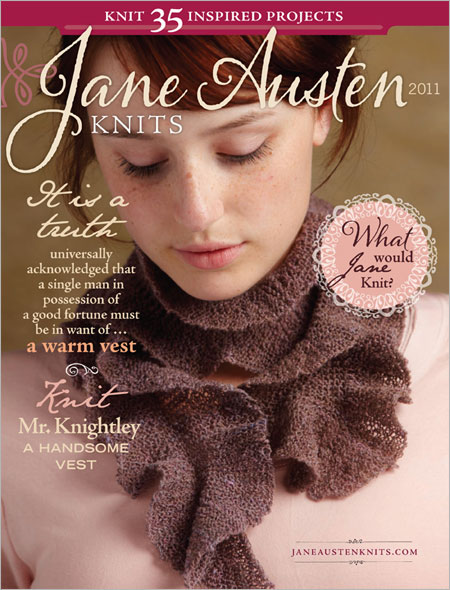 I picked this magazine up because clearly I am crazy. This Jane Austen obsession is becoming all consuming. I can’t even knit but the projects in this magazine are so enticing that I could not resist. I want to learn and I am told that learning to knit is not that difficult. So perhaps I will give it a go if only because I really, really want a knit Spencer to go with my Regency day dress. But perhaps, it is best if I start off simply beginning with a scarf or a pair of mitts.
Did Jane Austen knit? And if she did, what would she have knit? In a period before industrialization it is not unlikely that women knitted blankets, shawls, scarves, cushions, and stockings. Austen makes mention in Sense and Sensibility Mrs. Jenning’s plans for a knitting project and in an 1807 letter she describes her own knitting of a lap rug.
Martha’s rug is just finished, & looks well, tho’ not quite so well as I had hoped. I see no fault in the Border, but the Middle is dingy.–My mother desires me to say that she will knit one for you, as soon as you return to chuse the colours & pattern.
The knitting of stockings was an undertaking easily employed by the poor to supplement their meager incomes. It is probably not an unlikely supposition that Jane Austen and her sister, as daughters of a clergyman, may have knitted stockings for charitable distribution amongst the impoverished members of their village.
And besides, how can one not want to undertake some of these very beautiful pieces?
“Strengthen the female mind by enlarging it, and there will be an end to blind obedience.”
Mary Wollstonecraft, 1759–1797
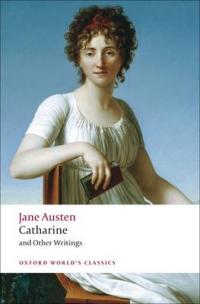 Today was a great day. I presented at a book discussion Catharine, or the Bower, an unfinished story written by Jane Austen when she was 16 years old. It is one of only two stories contained in Volume the Third of her youthful and ebullient writings, called the Juvenilia. Her father wrote of them “Effusions of Fancy by a Young Lady Consisting of Tales in a Style entirely new.” Austen’s earlier Juvenilia stories are literary parody consisting of coincidences, lurid horrors, and comic situations. They are boisterous and youthful and border the ridiculous and satirical towards the sentimental. Despite being written by such a young person (beginning at the age of 12) the stories are chock full of theft, drunkenness, sexual indiscretion, and lewdness, found to be most shocking by the Victorians. Her family refrained from publishing the volumes of the Juvenilia wanting to keep the reputation of the demure and devout maiden aunt pure. They were not published until 1933 (Volume the First), 1922 (Volume the Second), and 1951 (Volume the Third).
Catharine is considered important because, albeit raw, it intimates the maturity of her later published novels. Austen is beginning to direct her wit towards her interests of courtship, romance, and family relationships; the range and depth of her characterization, clarity of dialogue and action is emerging. Discernible are familiar character types that will be more fleshed out in the novels: self-centered, selfish, and empty-headed young ladies; thoughtless, idle, and seductive young gentlemen; vivacious, witty, and bright heroines, and conservative, over-protective and hypochondriac elders. Catharine also hints at acceptable principles of behavior and class distinction characteristic of her fully developed novels.
So, yes, today was a good day. I got to express my own “effusions of fancy” about my favorite author and am still allowed to join in next month when we will discuss A Vindication of the Rights of Woman by Mary Wollstonecraft. I already have this and a biography of the early feminist in my To Read list!
 I am in the midst of writing a one-page abstract for a break-out lecture I would like to present at the 2012 Jane Austen Society of North America’s Annual General Meeting to be held in Brooklyn, NY. Editing down a 40 minute lecture into a page is extremely difficult, harder even than childbirth! As you probably have guessed Jane Austen is involved and since the theme is Sex, Money & Power in Jane Austen’s Fiction those who know me will assume that sex is involved too. And they would be right! Stay tuned to see how I manage to introduce a topic not usually associated with the gentle world of Jane Austen.
In the meantime, back to writing!!

Image via Wikipedia
“Education begins the gentleman, but reading, good company and reflection must finish him.” John Locke, 1632–1704

Image via Wikipedia
It is, perhaps, not known Jane Austen’s personal connection to the Battle of Trafalgar.
Those at home always await patiently for word from their loved ones at sea and this was especially true 206 years ago when Jane Austen eagerly awaited the letters of her brother Capt. Francis W. Austen on board Canopus in the Mediterranean. Canopus was a prize ship (formerly L’Admiral) captured by Lord Nelson at the Battle of the Nile; Nelson subsequently was responsible for Frank taking command of this ship.
“You may rely upon all attention in my power to Capt. Austin [sic]. I hope to see him alongside a French 80 gun ship and he cannot be better placed than in the Canopus, who was once a French adl.’s ship and struck to me. Capt. A. I knew a little of before; he is an excellent young man.
I am, &c
Nelson and Bronte”
The French fleet had been alluding the British for months and the situation had become precarious. On board was Admiral Louis, Nelson’s second in command. Frank and the Admiral would be shocked when on September 28 Nelson arrived off Cadiz and gave orders for Canopus to sail to Gibraltar to fetch urgently needed water and stores. Louis complained of being sent away with hostilities promising to escalate. Nelson, assuring Canopus of its role as his right hand, promised that they would be back before the French dared to come out. Frank wrote home of his disappointment.
“Having borne our share in a tedious chase and anxious blockade, it would be mortifying indeed to find ourselves at last thrown out of any credit and emolument which would result from such an action. Such, I hope will not be our lot. ….if there has been an action with the combined fleets I shall ever consider the day on which I sailed from the squadron as the most inauspicious of my life.”
On October 19 the French and Spanish fleets left Cadiz, led by Admiral Villeneuve, making their way along the coast to Cape Trafalgar. On the morning of October 21 Nelson, glorious in his military honors hoisted the signal, “England expects every man to do his duty”. By the end of the day the British were victorious and Nelson was dead.
Frank could not help but lament his regret at having missed the battle which was only intensified by the news of Nelson’s death.
“To lose all share in the glory of a day which surpasses all which ever went before, is what I cannot think of with any degree of patience. ….A melancholy situation, great and important as must be the victory, it is alas! dearly purchased at the price paid for it.”
And as the female members of his family enhanced their needlework with the ‘Trafalgar stitch’ Frank Austen wrote of Nelson: “His memory will long be embalmed in the hearts of a grateful Nation, May those he left behind in the service strive to imitate so bright an example.”
HUZZAH!!!!
I have recently picked up a book that I can’t seem to embrace. Not because of the subject matter, March, an historical fiction by Geraldine Brooks, would normally be something I would be all over. It is the story of the absent father, Mr. March, of Louisa May Alcott’s Little Women and documents his experiences during the Civil War while his “little women” tend to the home fires. I will go back to it certainly but right now I have many on-going literary projects focusing on Jane Austen and I find myself preoccupied by her and repeatedly drawn into her world.
 This month my book club, The Petty Rebuttals, are reading Pride and Prejudice. It is my turn in the line-up, and since we collectively decided to read classics this cycle, I chose to introduce the group to Jane Austen. We are a mixed bag, evenly divided of those who have read P&P and those who have never had the pleasure. I am excited to give my insight to the group and share my love and enthusiasm for this novel (and of Jane) and only hope that I don’t overwhelm the group with my zeal. P&P is universally acknowledged (yes, that was intended) to be one of Austen’s best novels and I am currently trying to decide what of the novel I want to focus upon. Do I focus on character, storyline, class? My latest re-reading I specifically examined the characters of Elizabeth and Darcy, their imperfections and their strengths. I am intrigued how they evolve through the story and am struck by their capacity for self-awareness. Both come to terms with their pride and prejudice and become mindful of helping one another to overcome their shortcomings and give prominence to their assets. In other words, form a true partnership of like mind and heart. I think I will allow the group to take initiative though, regardless of where the discussion leads it, no doubt, will be stimulating.
I am also preparing to lead a discussion next month for the Jane Austen Reading Society. I am thrilled to be presenting  Catharine, or the Bower. A work of Jane Austen’s Volume, The Third of her Juvenilia. A charming piece, written in 1792 when she was only 16 years old. It is an unfinished story, predominately for the gratification of her family but has enticing elements present in her more mature works. The diversity in characterization and domestic realism is already evident in this short piece; it exhibits her wit and seemingly light and playful prose but also emerging is her perceptive understanding of class, gender, social decorum, and wealth. It is an important piece still raw in its youthful vivacity but intimates a more developed novelistic approach as she attempts to move away from her earlier mocking works. Catharine highlights the potential of the young Jane Austen’s scrutinizing eye and sardonic humor that fans know and love and appreciate.
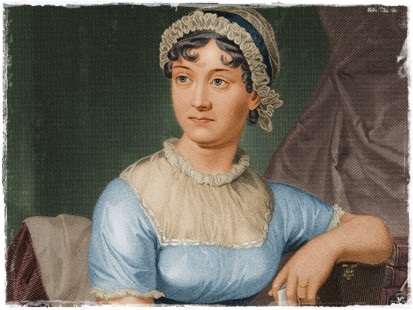
A lamentable picture of an insipid Victorian-friendly Jane Austen. She's wearing a wedding band for crying out loud!!!!
In anticipation of all of this, or perhaps in consequence of, I have undertaken a biography I have not read before. My favorite has always been that by Claire Tomalin but I decided to give David Nokes’s biography, Jane Austen: A Life, a go. Both biographers diverge from the generally accepted portrayal of Jane Austen as the staid and dour spinster, happy and accepting in her quiet life of little event. This myth of Jane Austen was perpetuated by her family soon after her death, in fact, her tombstone at Winchester Cathedral doesn’t even mention that she was an author and became more pronounced as Georgian England became Victorian England. In the Victorian era, a woman’s place was the domestic sphere; home life and motherhood were considered all that was necessary for a woman’s emotional fulfillment. Reading the little that is left of Jane Austen’s letters, her Juvenilia, and her novels it is clear that Austen was not willing to place her well-being in a virtuous ideal of femininity. She was feisty, opinionated, mirthful, and cutting. She wasn’t one to not cut to the chase and often described things the way they were, albeit with a derisive wit. Comments to her sister in letters emphasize her dry humor:
“I give you joy of our new nephew, and hope if he ever comes to be hanged it will not be till we are too old to care about it.” [upon the birth of a nephew]
“Here I am once more in this scene of dissipation and vice, and I begin already to find my morals corrupted.” [upon arrival in London]
“How horrible it is to have so many people killed! And what a blessing that one cares for none of them!” [commenting on the Peninsular War]
“You express so little anxiety about my being murdered under Ash Park Copse by Mrs. Hulbert’s servant, that I have a great mind not to tell you whether I was or not.”
I love the “rebellious, satirical, and wild” Austen! This Jane and I could be great friends unlike the virtuous, devoted, and retiring maiden Aunt popularly portrayed for nearly 200 years.

Image via Wikipedia
As the air gets chillier, the days shorter, and the memory of summer begin to gather in a miasma I often find myself reflecting on more light-hearted times as I physically and mentally prepare for the short, cold days of winter. Often melancholia sets in as the leaves begin to turn and finally fall; a reminder that all care-free delights must end. But even as the earth prepares itself to sleep there is a sense of promise, an assurance of future renewal. Since I, myself, lack the talent to capture the essence of what autumn means to me I offer an ode from my favorite poet of the Romantic period, John Keats.
To Autumn
John Keats, 1795–1821Season of mists and mellow fruitfulness
Close bosom-friend of the maturing sun
Conspiring with him how to load and bless
With fruit the vines that round the thatch-eaves run;
To bend with apples the moss’d cottage-trees,
And fill all fruit with ripeness to the core;
To swell the gourd, and plump the hazel shells
With a sweet kernel; to set budding more,
And still more, later flowers for the bees,
Until they think warm days will never cease,
For Summer had o’er-brimm’d their clammy shells.Who hath not seen thee oft amid thy store?
Sometimes whoever seeks abroad may find
Thee sitting careless on a granary floor,
Thy hair soft-lifted by the winnowing wind:
Or on a half-reap’d furrow sound asleep,
Drows’d with the fume of poppies, while thy hook
Spares the next swath and all its twined flowers:
And sometimes like a gleaner thou dost keep
Steady thy laden head across a brook;
Or by a cider-press, with patient look,
Thou watchest the last oozings hours by hours.Where are the songs of Spring? Ay, where are they?
Think not of them, thou hast thy music too,-
While barred clouds bloom the soft-dying day,
And touch the stubble-plains with rosy hue;
Then in a wailful choir the small gnats mourn
Among the river sallows, borne aloft
Or sinking as the light wind lives or dies;
And full-grown lambs loud bleat from hilly bourn;
Hedge-crickets sing; and now with treble soft
The red-breast whistles from a garden-croft;
And gathering swallows twitter in the skies.

 A Latter-day Bluestocking